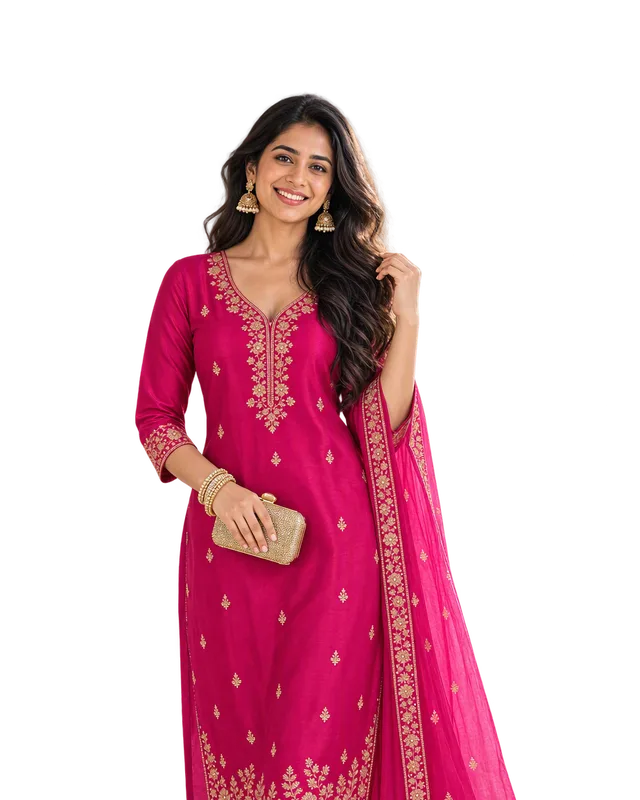


Indian clothes or your own?
Both are fine. Dressy Western clothes are accepted at most events, above all the evening reception. Indian clothes help you blend in at the ceremony and the sangeet, and hosts are usually glad to see a guest in them. What matters more than the choice is color, how much skin shows, and whether you can sit and dance in it.
Choose Indian clothes when the invitation or the couple's wedding website asks for "Indian attire" or "traditional dress", when you want to join in, or when the couple offers to help you find something.
Choose your own clothes when you are going to one event, when time is short, or when a new outfit for each event is more than you want to spend. Pick your brightest, dressiest pieces, and cover a little more than you would at a Western wedding.
Is it OK to wear Indian clothes if you are not Indian? Yes. WeddingWire, Zola and Cbazaar all suggest Indian clothes to guests. On the bindi, a small decoration worn on the forehead, WeddingWire quotes Tejel Patel of Ambiance by Tejel in Santa Clara, California: "We love to see other cultures taking ours on." Zola adds a caution about fusion outfits, which mix Indian and Western pieces: if they are not done well, they can come across as mocking the culture. So wear an outfit the way it is meant to be worn, a kurta with its pants and a saree draped properly, and ask someone in the wedding party if you are not sure.
Before you plan anything, find out which events you are invited to. An Indian wedding often has several events, sometimes over more than one day, and a guest may be invited to only some of them.
Indian wedding guest outfits, event by event
This is the short version. Each event has its own part below.
| Event | Indian clothes | From your own closet |
|---|---|---|
| Mehndi: a daytime henna party | A light cotton kurta set; a printed lehenga. Men: a cotton or linen kurta | A bright cotton dress with sleeves. Men: chinos and a colorful linen shirt |
| Haldi: turmeric paste for the couple | An old or cheap cotton kurta, often yellow | Washable clothes you do not mind staining |
| Sangeet: an evening of music and dancing | A lehenga, an anarkali or a sharara. Men: a kurta with a Nehru jacket | A jewel-color midi dress you can dance in. Men: a suit or blazer with a bright shirt |
| Ceremony: the religious wedding | A saree, a lehenga or a formal suit set. Men: a sherwani, a bandhgala or a kurta set | A dress or skirt below the knee, with sleeves or a shawl. Men: a suit |
| Reception: the big evening party | Your dressiest saree or lehenga. Men: a bandhgala or sherwani | An evening dress or a dark suit, as the invitation says |

Mehndi and haldi outfits
The mehndi is the henna party, usually held in the daytime before the wedding. Henna is a paste drawn on the hands in fine patterns. It dries on the skin and leaves a brown stain that fades slowly. Guests sit for a long time while it is drawn, so wear something soft and easy. Sleeves that end above the wrist keep wet henna off the fabric. WeddingWire notes that some mehndi events are for women only, so check that you are invited.
Women: a light cotton kurta set (a long tunic with pants) in yellow, pink, green or orange, or a sundress with short sleeves. Men: a cotton or linen kurta, or light chinos with a bright linen shirt.
The haldi is a smaller event where family and close friends rub turmeric paste on the couple. Turmeric stains yellow and may not wash out, so wear clothes you do not mind losing. If the hosts name a color for it, wear that. Our haldi outfit ideas for women and men list more outfits and what to skip.

Sangeet outfits
The sangeet is a night of music and dancing, often with songs and dances by the families. Wear something you can move in, and shoes that grip the floor.
Women: a lehenga, a long, full skirt worn with a short blouse and a long scarf called a dupatta. An anarkali, a long kurta that flares like a dress, and a sharara, wide flared pants with a short kurta, work too. From your own closet, a midi or maxi dress in a jewel color, like emerald, cobalt, fuchsia or gold, with block heels or dressy flats.
Men: a kurta with a Nehru jacket (a short jacket with no sleeves and a stand-up collar), or a bandhgala (a jacket with a closed collar). From your own closet, a suit or a blazer with a bright shirt or pocket square. Our guide to sangeet outfits for men has eight looks and the shoes to dance in.
The wedding ceremony
The ceremony is the religious wedding and the most traditional part of the day. It can last two to three hours, and at a Sikh wedding guests sit on the floor. So dress modestly and comfortably: shoulders covered, a hem below the knee, nothing tight, short or see-through.
Women: a saree, a lehenga or a formal suit set (a long kurta with pants and a dupatta). From your own closet, a midi or maxi dress with sleeves, or a long skirt and a blouse, with a shawl you can put over your shoulders. Men: a sherwani (a long, fitted coat worn over pants), a bandhgala or a kurta set. A suit and tie is fine too.
Shoes off, and a head cover at a gurdwara
If the ceremony is in a temple or a gurdwara, the Sikh place of worship, you will usually take your shoes off at the door. In a gurdwara, men and women also cover their heads, and some gurdwaras keep scarves near the door for visitors. Bring your own anyway: a dupatta, a light scarf, or for men a large handkerchief tied over the hair. Wear shoes that slip on and off easily.
The reception
The reception is the big evening party, often in a hotel or a banquet hall. It is the event where Western clothes fit best. Follow the invitation: black tie means a tuxedo or a floor-length gown, and cocktail means a suit or a dressy knee-length or midi dress. Our guide to wedding dress codes explains each one.
Many guests wear their dressiest Indian outfit here: a silk saree, a heavy lehenga, a velvet bandhgala or a sherwani. For suits, bandhgalas and tuxedos, see reception outfits for men.
Colors to wear and colors to skip
- Skip red. It is the bride's traditional color at many Indian weddings. Wear it only if the couple says it is fine.
- Skip all-white. In much of India and South Asia, white is worn at funerals.
- Skip all-black at the ceremony. Some families see it as unlucky. At an evening reception black is more accepted, above all with gold jewelry or a bright scarf.
- Wear bright, rich colors. Emerald, royal blue, fuchsia, coral, mustard, purple, teal and gold are all safe.
If the couple's wedding website gives a color for each event, follow it before anything here.
Borrow, rent or buy one Indian outfit
You do not need a new outfit for every event. If you get only one Indian outfit, get it for the ceremony or the sangeet, and wear your own clothes to the rest.
- Borrow. The couple or an Indian friend may lend you one and help you put it on.
- Rent. Some online shops rent Indian outfits for a few days. Check the return date against your travel.
- Buy. Try an Indian clothing shop in your city, or order online. Cbazaar's guest guide says to order three to four weeks ahead if the outfit needs changes to fit. For a first saree, a pre-draped one is easiest: the pleats are already stitched, so it goes on almost like a skirt.
- Men: one kurta set with a Nehru jacket covers the mehndi and the sangeet. Add a second jacket and it looks new the next night.
Try the whole outfit at home, with the shoes and the bag. Sit on the floor, climb some stairs and lift your arms. Pleats that slip, a hem that catches and shoes that pinch are easier to fix at home than at the wedding.

A winter Indian wedding in the US or UK
In a US or UK winter, the cold comes in the gaps: the walk from the car, photos outside, a tent, a drafty hall. Fabilicious Fashion, an online shop, warns in its guide for UK guests that a tent in October or a cold hall in February is normal there.
- Over the outfit: a wool coat in a plain color that comes off at the door. A wool shawl over a saree or a kurta looks right indoors too.
- Under the outfit: a thin thermal top under a kurta or a sherwani, and thermal leggings under a lehenga or a long skirt.
- Shoes: closed flats or low boots for the walk. Carry dressier shoes if you want them, and remember they may come off at the ceremony.
- Fabric: heavier silk and velvet keep you warmer than thin chiffon.
For layers that hide under a saree or a kurta, see how to stay warm in Indian clothes. If the wedding is in India, our guide to wedding guest outfits in India covers the weather and customs there.
Plan each outfit from your own closet
Ukti is our app. Take photos of your clothes, and with ten pieces in your closet, pick "wedding and party" as the occasion. It builds outfits from your own clothes: a safe one, a bold one and a stretch. You can also type the event in your own words, like "sangeet, Saturday night, dancing", and the app shows how it read them before it styles you.
Sources read on 12 November 2026. WeddingWire's guide for Indian wedding guests: the events, women-only mehndi events, ceremonies of two to three hours, sitting on the floor at Sikh weddings, red, white and black, shoes off in a house of worship, Indian clothes for guests, and Tejel Patel on the bindi. Zola's guide: Western and Indian clothes, black and white, shoes off at sacred places, and the warning on fusion outfits. Cbazaar's US guest guide: the four main events, Indian clothes for guests, black at the reception, and ordering three to four weeks ahead. Fabilicious Fashion's UK guide: the haldi and UK venues in the cold. Covering the head and taking shoes off in a gurdwara: FEMA's tip sheet on Sikh communities. Customs differ between families, regions and faiths. When in doubt, ask the couple.