

How to measure
Stand straight with your arms at your sides, in close clothes or underwear. Keep the tape level and snug, but do not pull it tight.
- Bust. Around the fullest part of your chest, in a bra that fits well.
- Waist. Around the narrowest part of your middle, usually just above the belly button.
- Hips. Around the widest part of your hips and seat.
Measure twice and use the second number if the two differ. A friend can hold the tape level at the back, which is where most mistakes happen.
How the calculator decides
It checks four things, in this order, and stops at the first one that fits:
| Shape | The rule | In centimeters |
|---|---|---|
| Apple | Your waist measures more than both your bust and your hips | The same |
| Pear | Your hips measure at least 3.6 inches more than your bust | 9.14 cm |
| Inverted triangle | Your bust measures at least 3.6 inches more than your hips | 9.14 cm |
| Hourglass | Bust and hips within 3.6 inches, and the waist at least 9 inches smaller than the bust or 10 inches smaller than the hips | 22.86 cm or 25.4 cm |
| Rectangle | Bust and hips within 3.6 inches, and a smaller gap at the waist than an hourglass | The same |
The numbers for pear, inverted triangle, hourglass and rectangle are the ones Calculator.net publishes. They come from a study of body shapes in the International Journal of Clothing Science and Technology, which sorts women into seven shapes. Calculator.net's seven shapes have no apple, and we do not ask for the high hip, so the seven become four here. Its top hourglass counts as an hourglass or an inverted triangle, and its bottom hourglass and most of its spoon count as pears, so the same numbers can get a different name there. The apple check, which comes first, is our own rule; Calculator.net uses the word apple for the inverted triangle.
What each shape means for your clothes
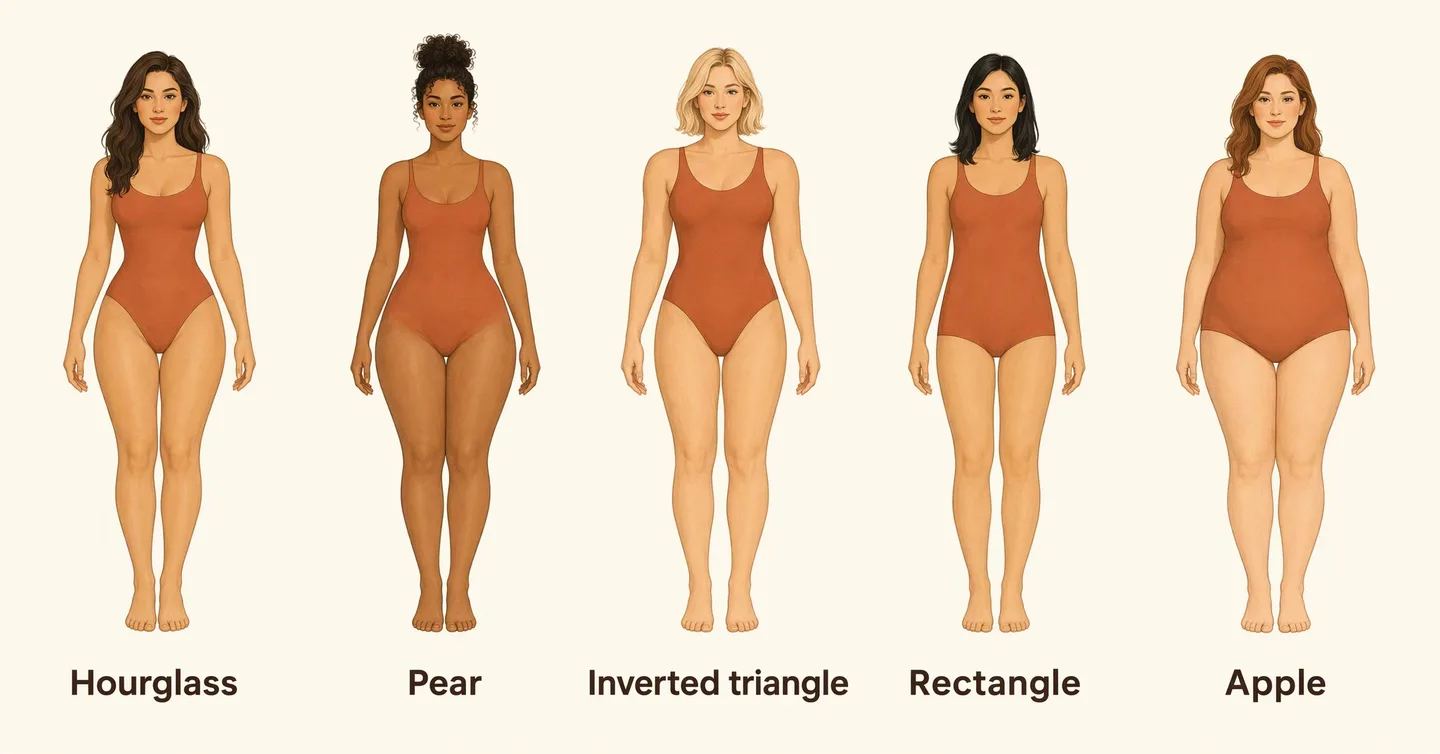
- Hourglass. Wear clothes that follow your waist: wrap dresses, belted coats, tops tucked into high-waist pants.
- Pear. Put color and detail on top, and keep the bottom half plain and dark.
- Inverted triangle. Keep the top quiet, with V-necks, and add width below, with wide-leg pants or a full skirt.
- Rectangle. Make a waist with a belt or a tucked top, or keep the straight line on purpose.
- Apple. Make one long line down the front: V-necks, open jackets, tops that fall straight from the chest.
Each shape has a full part, with what to skip and one outfit, in our guide on how to dress for your body type.
If the answer feels wrong
Many people sit between two shapes, and a few millimeters on the tape can move you from one to the other. Measure again, then read the parts for both shapes and keep the advice that looks right in the mirror. The shapes are a place to start, not a rule about what you may wear.
Two answers are the most likely to surprise you. The apple check only counts when your waist is the biggest number. If your middle looks widest in the mirror but your waist measures a little less than your bust, the calculator says rectangle, so read the apple part too. And the calculator cannot see your shoulders: if it says inverted triangle and your shoulders are narrow, the tape is reading a full bust, so keep the V-necks and skip the advice about shoulders.
Where this comes from, read on 16 November 2026: the shape rules and the 2005 North Carolina State University numbers are from Calculator.net's body type calculator page, which cites Lee, Istook, Nam and Park, "Comparison of body shape between USA and Korean women", International Journal of Clothing Science and Technology, 2007. We did not read the study itself. Folding the seven shapes Calculator.net lists into four, adding the apple, and the clothing advice are our own. This is style advice, not health advice.